
A PyTorch framework for multi-target prediction with flexible two-branch neural networks.


Documentation · Quick start · Input guide · Colab demos · Issues
DeepMTP learns from observations of the form (instance, target, score). It
encodes instances and targets independently, fuses their representations, and
predicts the score for each pair. The same interface covers:
- multi-label classification (MLC);
- multivariate regression (MTR);
- multi-task learning (MTL);
- dyadic prediction (DP); and
- matrix completion (MC).
Use dense, sparse, tabular, sequence, foundation-model, molecular-graph, image, learned-ID, composite, or custom inputs on either branch. DeepMTP also provides reproducible checkpoints, PEFT/LoRA support, experiment tracking, and random-search or Hyperband optimization without making those integrations mandatory.
Upgrading from DeepMTP 0.0.22? Read the 0.0.22 → 0.0.23 migration guide and changelog before reusing an existing experiment.
| Need | DeepMTP support |
|---|---|
| One model across MTP problem families | A shared two-branch abstraction for MLC, MTR, MTL, DP, and MC |
| Generalize to new entities | Explicit validation settings for known or novel instances and targets |
| Mix representation types | Built-in dense, sparse, tabular, sequence, foundation, graph, image, ID, and composite encoders |
| Choose how branches interact | Dot product, concatenation plus MLP, or Kronecker-product fusion |
| Train larger models safely | Gradient accumulation, gradient clipping, early stopping, and deterministic data handling |
| Track and restore experiments | Versioned checkpoints, preprocessing provenance, TensorBoard, and Weights & Biases Artifacts |
| Adapt pretrained encoders efficiently | Hugging Face Transformers with frozen, full fine-tuning, or PEFT/LoRA modes |
DeepMTP supports Python 3.10–3.14. CPU execution is fully supported; a CUDA GPU is optional.
python -m venv .venv
source .venv/bin/activate  # Windows: .venv\Scripts\activate
python -m pip install --upgrade pip
python -m pip install DeepMTP
Install only the integrations you use:
| Extra | Install command | Adds |
|---|---|---|
| Datasets | pip install "DeepMTP[datasets]" |
Downloadable benchmark datasets |
| Foundation | pip install "DeepMTP[foundation]" |
Transformers and PEFT/LoRA |
| Graph | pip install "DeepMTP[graph]" |
PyTorch Geometric encoders |
| HPO | pip install "DeepMTP[hpo]" |
ConfigSpace, random search, and Hyperband |
| Image | pip install "DeepMTP[image]" |
Torchvision models and transforms |
| Sparse | pip install "DeepMTP[sparse]" |
SciPy sparse matrices |
| Streamlit | pip install "DeepMTP[streamlit]" |
Streamlit progress adapters |
| Tracking | pip install "DeepMTP[tracking]" |
TensorBoard and Weights & Biases |
| Visualization | pip install "DeepMTP[visualization]" |
Rich terminal architecture diagrams and SVG export |
| Everything | pip install "DeepMTP[all]" |
All runtime integrations |
For GPU acceleration, install the appropriate PyTorch build using the official PyTorch selector first. See the installation guide for source and Conda workflows.
This complete CPU example trains on a synthetic multi-label dataset, evaluates it, and returns pair-level predictions. It requires no downloads or optional dependencies.
import numpy as np

from DeepMTP import DeepMTP, DeepMTPConfig, data_process

rng = np.random.default_rng(42)
scores = (
    np.arange(24)[:, np.newaxis] + np.arange(4)[np.newaxis, :]
) % 2
data = {
    "train": {
        "y": scores,
        "X_instance": rng.normal(size=(24, 3)),
        "X_target": None,
    }
}
train, validation, test, data_info = data_process(
    data,
    validation_setting="B",
)

config = DeepMTPConfig(
    validation_setting=data_info["detected_validation_setting"],
    problem_mode=data_info["detected_problem_mode"],
    general_architecture_version="dot_product",
    compute_mode="cpu",
    num_workers=0,
    train_batchsize=16,
    val_batchsize=16,
    num_epochs=1,
    metrics=["accuracy"],
    metrics_average=["macro"],
    evaluate_val=True,
    use_early_stopping=False,
    save_model=False,
    results_path="results",
    experiment_name="quickstart",
    instance_branch_architecture="MLP",
    instance_branch_input_dim=data_info["instance_branch_input_dim"],
    instance_branch_nodes_per_layer=[8],
    target_branch_architecture="MLP",
    target_branch_input_dim=data_info["target_branch_input_dim"],
    target_branch_nodes_per_layer=[8],
    embedding_size=4,
)

model = DeepMTP(config)
validation_results = model.train(train, validation, test)
test_results, predictions = model.predict(test, return_predictions=True)
DeepMTP writes config.json, summary.txt, and any enabled logs or checkpoint
below results/quickstart. The four core steps remain the same for every input
type:
- Describe observed scores and optional side information.
- Call
data_processwith the intended validation setting and input kinds. - Build a validated
DeepMTPConfig. - Train with
DeepMTP.trainand infer withDeepMTP.predict.
Let x denote an instance, t a target, and y their observed relationship.
DeepMTP learns two encoders:
instance x ──> instance encoder ──> pₓ ──┐
                                         ├──> fusion ──> score ŷ(x, t)
target t   ──> target encoder   ──> qₜ ──┘
The score can be binary, multiclass, or continuous. Dot-product fusion requires equal branch widths. MLP and Kronecker fusion can combine unequal widths.
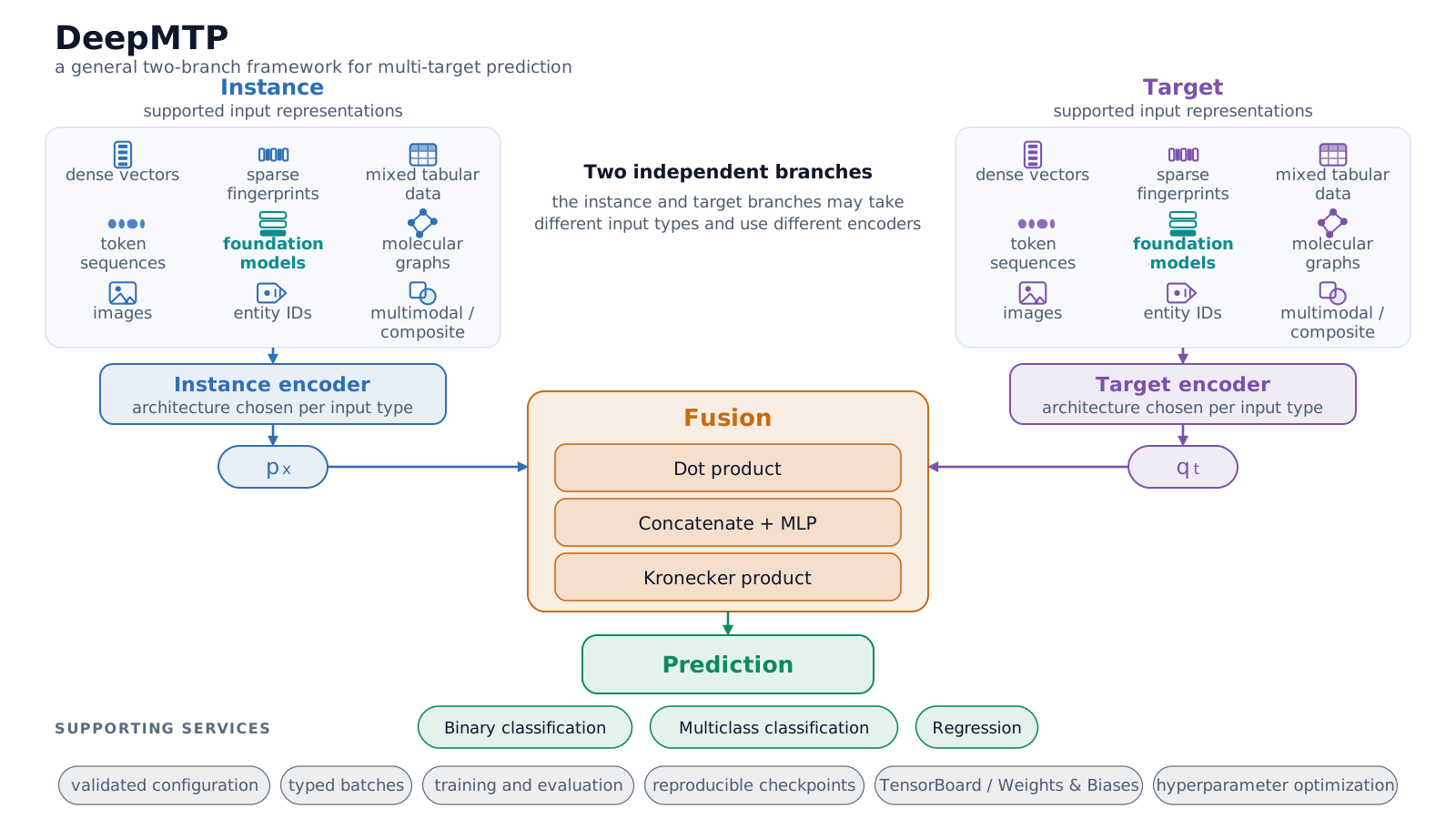
Inspect the same architecture directly from Python or a saved configuration:
from DeepMTP import print_architecture

print_architecture(config)
deepmtp architecture results/quickstart/config.jsonInstall DeepMTP[visualization] for responsive Rich panels, parameter
statistics, and SVG export. Without it, DeepMTP falls back to a portable plain
text representation. See the architecture visualization guide.
The validation setting states which entity types may be unseen at evaluation time. Novel entities require side information; a learned ID lookup cannot represent an entity absent from training.
| Setting | Evaluation pairs | Instance side information | Target side information |
|---|---|---|---|
| A | Known instances × known targets | Optional | Optional |
| B | Novel instances × known targets | Required | Optional |
| C | Known instances × novel targets | Optional | Required |
| D | Novel instances × novel targets | Required | Required |
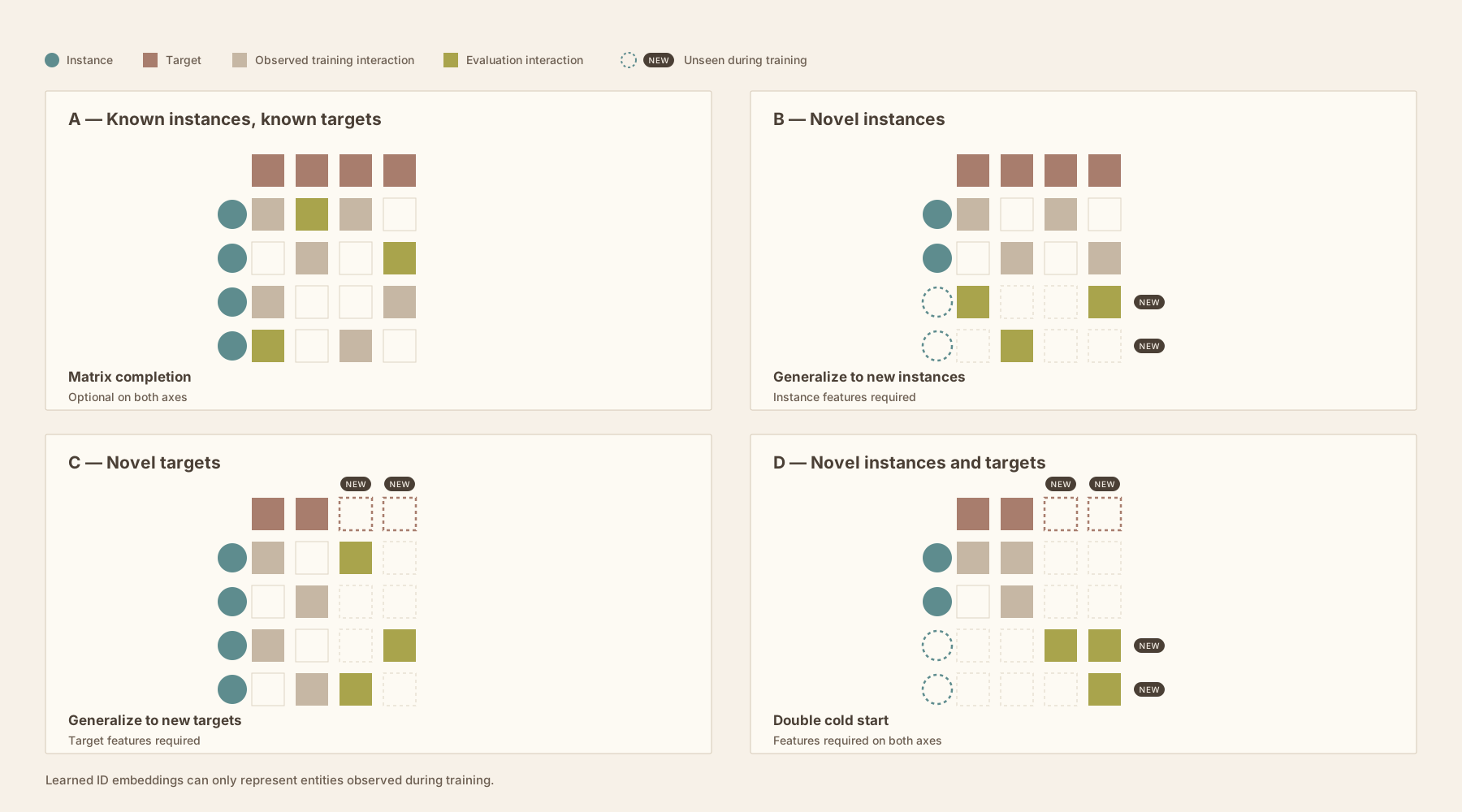
See the configuration guide for split semantics and validation rules.
Each branch selects an encoder independently. A compound–protein model can, for example, combine a molecular graph branch with a protein foundation-model branch.
| Architecture | Input | Good fit | Dependency |
|---|---|---|---|
MLP |
Dense numeric vectors | Descriptors and precomputed embeddings | Core |
SPARSE |
COO/CSR or SciPy matrices | Fingerprints, bag-of-words, indicators | Core for PyTorch; sparse for SciPy |
TABULAR |
Numeric and categorical columns | Mixed entity metadata | Core |
SEQUENCE |
Token IDs and masks | Proteins, SMILES, text | Core; foundation for Hugging Face |
GRAPH |
Homogeneous PyG graphs | Molecular graphs | graph |
CONV |
Images | Visual entity representations | image |
EMBEDDING |
Zero-based entity IDs | Known entities without side features | Core |
COMPOSITE |
Named component mapping | Multimodal or partially missing inputs | Depends on components |
CUSTOM |
User-defined batch type | Domain-specific encoders | Core |
Use EMBEDDING rather than a dense one-hot MLP when entities are known during
training. Settings B, C, and D reject an ID branch on any novel entity axis.
from DeepMTP import DeepMTPConfig

number_of_instances = 24
number_of_targets = 4

config = DeepMTPConfig(
    validation_setting="A",
    problem_mode="classification",
    general_architecture_version="dot_product",
    metrics_average=["micro"],
    instance_branch_architecture="EMBEDDING",
    instance_branch_input_dim=number_of_instances,
    target_branch_architecture="EMBEDDING",
    target_branch_input_dim=number_of_targets,
    embedding_size=32,
)TABULAR keeps numeric and categorical preprocessing explicit and stores the
fitted training-only state for compatible restoration.
import pandas as pd

from DeepMTP import DeepMTPConfig

instance_features = pd.DataFrame(
    {
        "id": [0, 1, 2],
        "age": [22.0, None, 41.0],
        "site": ["Ghent", "Paris", "Ghent"],
    }
)

tabular_schema = {
    "numeric_columns": ["age"],
    "categorical_columns": {
        "site": {
            "categories": ["Ghent", "Paris"],
            "embedding_dim": 2,
        }
    },
    "numeric_normalization": "standard",
    "numeric_missing": "mean",
    "categorical_unknown": "unknown",
    "feature_gating": True,
}

number_of_targets = 4

config = DeepMTPConfig(
    validation_setting="B",
    problem_mode="classification",
    general_architecture_version="dot_product",
    instance_branch_architecture="TABULAR",
    instance_branch_tabular_schema=tabular_schema,
    instance_branch_nodes_per_layer=[16],
    target_branch_architecture="EMBEDDING",
    target_branch_input_dim=number_of_targets,
    embedding_size=8,
)
Read the tabular guide for missing-value, normalization, and unknown-category policies.
SPARSE preserves sparsity through splitting, batching, and the first
projection. Apply sparse-safe preprocessing upstream; legacy dense scaling is
rejected rather than silently densifying the data.
config = DeepMTPConfig(
    validation_setting="B",
    problem_mode="classification",
    instance_branch_architecture="SPARSE",
    instance_branch_input_dim=fingerprint_width,
    instance_branch_nodes_per_layer=[128, 32],
    target_branch_architecture="MLP",
    target_branch_input_dim=number_of_targets,
    target_branch_nodes_per_layer=[32],
    embedding_size=32,
)
See the sparse-input guide for SciPy support, explicit IDs, and benchmark tooling.
SEQUENCE batches contain dynamically padded token IDs, attention masks, and
original lengths. Choose gru, conv1d, or transformer; all ignore padded
positions.
from DeepMTP import DeepMTPConfig

vocabulary_size = 32
number_of_targets = 4

config = DeepMTPConfig(
    validation_setting="B",
    problem_mode="classification",
    general_architecture_version="dot_product",
    instance_branch_architecture="SEQUENCE",
    instance_branch_input_dim=vocabulary_size,
    instance_branch_sequence_encoder="transformer",
    instance_branch_sequence_embedding_dim=16,
    instance_branch_sequence_transformer_num_heads=4,
    instance_branch_sequence_transformer_feedforward_dim=64,
    instance_branch_sequence_num_layers=1,
    instance_branch_sequence_padding_idx=0,
    target_branch_architecture="MLP",
    target_branch_input_dim=number_of_targets,
    target_branch_nodes_per_layer=[8],
    embedding_size=8,
)
Raw token rows must be unpadded and cannot contain the configured padding ID. The sequence guide documents collation and each encoder.
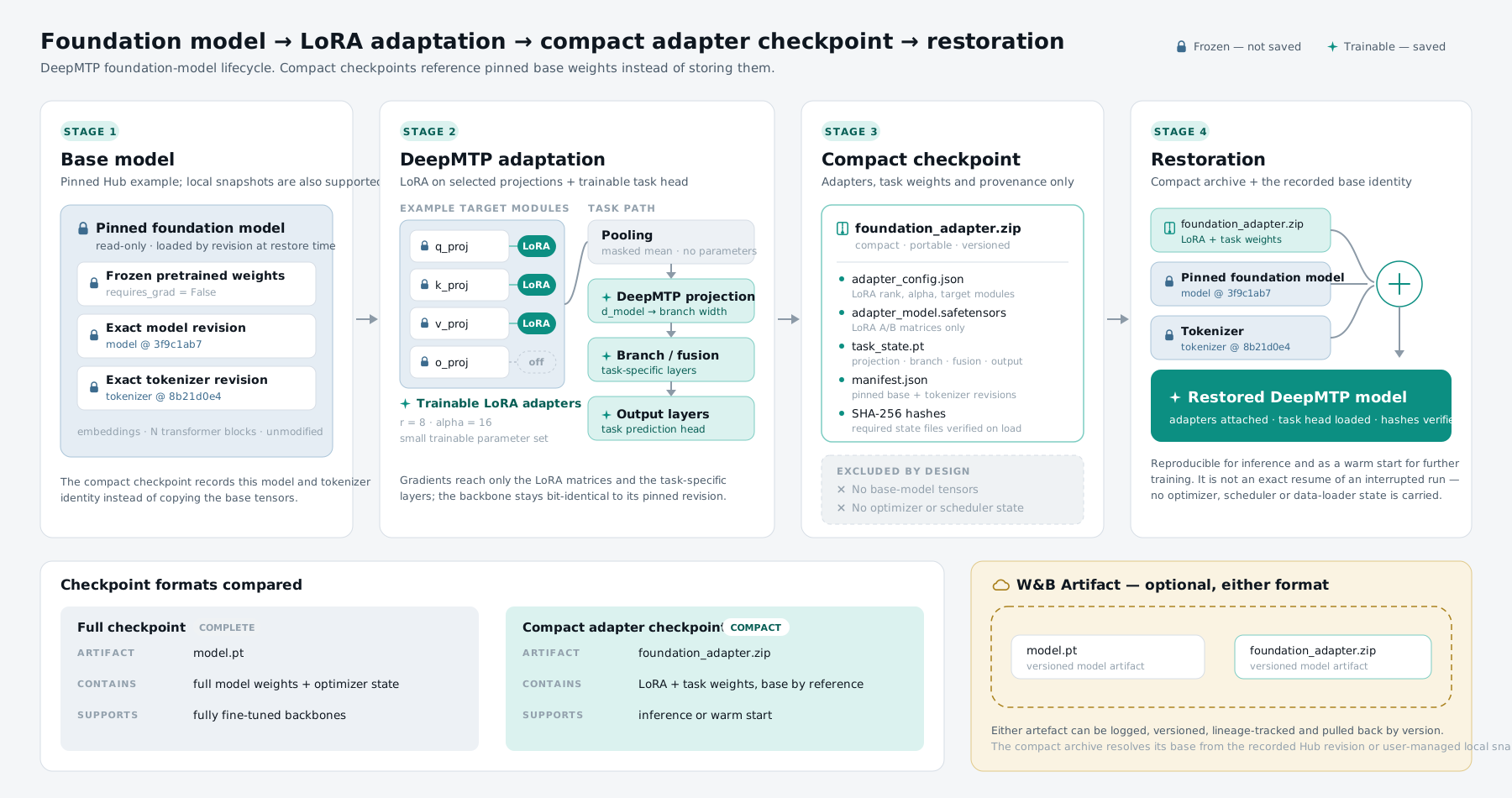
The optional Hugging Face adapter uses AutoTokenizer and AutoModel for
protein, chemical, biomedical, or general text encoders. Training modes are
frozen, full, and lora.
from DeepMTP import FoundationLoRASpec, FoundationModelSpec

protein_model = FoundationModelSpec(
    model_name="facebook/esm2_t6_8M_UR50D",
    revision="<pinned-model-commit>",
    pooling="masked_mean",
    train_mode="lora",
    lora=FoundationLoRASpec(
        rank=8,
        alpha=16,
        dropout=0.1,
        target_modules=("query", "value"),
    ),
    max_length=1024,
)
Tokenize raw values with tokenize_foundation_sequences, then pass the
normalized specification to a SEQUENCE branch with
sequence_encoder="foundation". Hub revision capture, pooling, length policy,
composite use, compact adapter checkpoints, and supported reference models are
covered in the foundation-model guide.
GRAPH consumes homogeneous torch_geometric.data.Data objects and uses GIN
or edge-aware GINE layers with mean, sum, or max graph pooling. Each graph
needs floating node features, COO edge_index, and optional floating edge
features. See the graph guide.
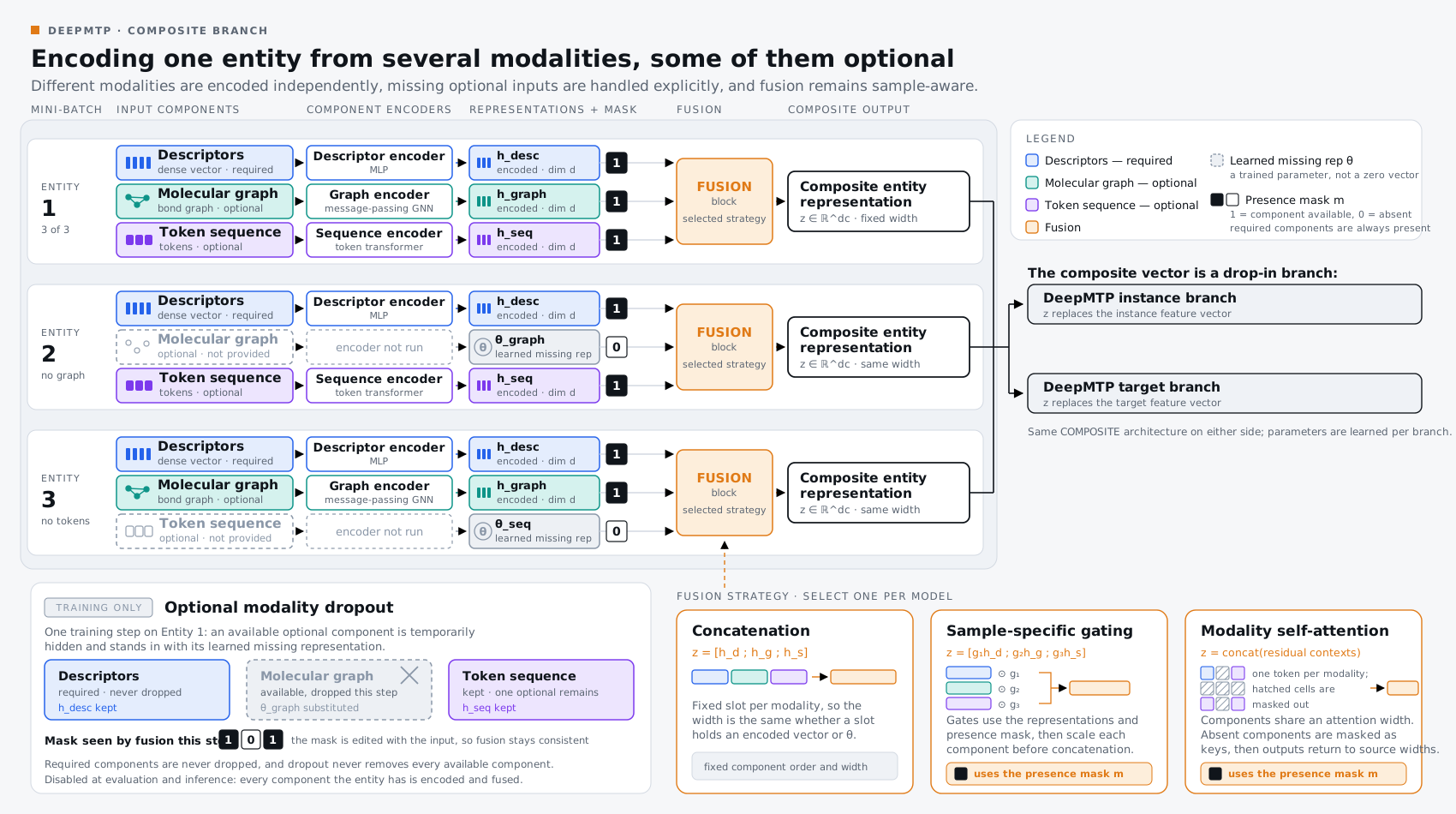
COMPOSITE combines named dense, sparse, graph, sequence, ID, or tabular
components. Fusion can use concatenation, sample-specific gates, or modality
self-attention. Optional components carry presence masks and learned missing
representations; training-only modality dropout can improve robustness.
config = DeepMTPConfig(
    validation_setting="B",
    problem_mode="classification",
    general_architecture_version="mlp",
    instance_branch_architecture="COMPOSITE",
    instance_branch_composite_fusion="attention",
    instance_branch_composite_attention_dim=32,
    instance_branch_composite_attention_num_heads=4,
    instance_branch_composite_components={
        "descriptors": {
            "architecture": "MLP",
            "input_dim": descriptor_width,
            "output_dim": 16,
        },
        "tokens": {
            "architecture": "SEQUENCE",
            "input_dim": vocabulary_size,
            "output_dim": 16,
            "embedding_dim": 16,
            "optional": True,
        },
    },
    instance_branch_composite_modality_dropout=0.2,
    target_branch_architecture="MLP",
    target_branch_input_dim=number_of_targets,
    target_branch_nodes_per_layer=[32],
    comb_mlp_nodes_per_layer=[32],
)
The composite-input guide explains component schemas, missingness, and fusion behavior.
Binary classification is the backward-compatible classification default and uses logits with binary cross entropy. Regression defaults to mean squared error and also supports MAE and Huber losses.
Multiclass mode predicts exactly one of at least three classes. Labels must be zero-based integer IDs, and every declared class must occur in training data.
import numpy as np

from DeepMTP import DeepMTPConfig, data_process

scores = (
    np.arange(18)[:, np.newaxis] + np.arange(3)[np.newaxis, :]
) % 3
train, validation, test, data_info = data_process(
    {"train": {"y": scores}},
    validation_setting="A",
    classification_mode="multiclass",
)

config = DeepMTPConfig(
    validation_setting=data_info["detected_validation_setting"],
    problem_mode="classification",
    classification_mode=data_info["detected_classification_mode"],
    num_classes=data_info["detected_num_classes"],
    metrics=["accuracy", "f1_score", "auroc"],
    metrics_average=["micro"],
    multiclass_average="macro",
    compute_mode="cpu",
    instance_branch_architecture="EMBEDDING",
    instance_branch_input_dim=data_info["instance_branch_input_dim"],
    target_branch_architecture="EMBEDDING",
    target_branch_input_dim=data_info["target_branch_input_dim"],
    embedding_size=8,
)| Problem | Default loss | Metrics |
|---|---|---|
| Binary classification | Binary cross entropy with logits | Hamming loss, AUROC, AUPR, accuracy, recall, precision, F1 |
| Multiclass classification | Cross entropy | Accuracy, recall, precision, F1, AUROC, AUPR |
| Regression | Mean squared error | RMSE, MSE, MAE, R² |
metrics_average groups observations globally, by target, or by instance.
multiclass_average combines classes within applicable multiclass metrics.
See the multiclass guide
for prediction columns and averaging rules.
config = DeepMTPConfig(
    # architecture and task settings...
    gradient_accumulation_steps=4,
    gradient_clip_norm=1.0,
)
Accumulation combines observation-weighted microbatches before an optimizer
step, including an uneven final group. Clipping applies a global norm limit at
optimizer-step boundaries. Their inert defaults (1 and None) preserve
historical behavior.
| Format | File | Contains | Use it for |
|---|---|---|---|
full (default) |
model.pt |
Model, optimizer, configuration, provenance | Restoration, optimizer warm starts, and fully fine-tuned backbones |
foundation_adapter |
foundation_adapter.zip |
PEFT adapters, DeepMTP task weights, identities, hashes | Compact LoRA inference or warm starts |
restored = DeepMTP(
    {
        "results_path": "./results",
        "experiment_name": "restored",
    },
    checkpoint_dir="./results/training-run/model.pt",
)
Compact adapter checkpoints exclude base-model and optimizer weights. Fully
fine-tuned foundation models therefore require full. Both formats record
preprocessing and environment metadata; load checkpoints only from trusted
sources. Read the checkpoint guide
for replay and compatibility details.
Set use_tensorboard_logger=True for local TensorBoard events. For W&B, supply
the project and entity; richer uploads remain explicitly opt-in.
config = DeepMTPConfig(
    # architecture and task settings...
    wandb_project_entity="my-team",
    wandb_project_name="deepmtp",
    wandb_run_name="protein-lora",
    wandb_group="ablations",
    wandb_tags=["protein", "lora"],
    wandb_watch="gradients",
    wandb_log_model_artifact=True,
    wandb_model_artifact_aliases=["latest", "best"],
    wandb_log_predictions=True,
)
DeepMTP records epoch-aware metrics, summaries, failures, parameter counts, bounded prediction tables, model Artifacts, input lineage, and optional W&B Registry links. Restore either checkpoint format directly:
model = DeepMTP.from_wandb_artifact(
    "my-team/deepmtp/deepmtp-model:best",
    {
        "results_path": "./results",
        "experiment_name": "restored",
    },
)
See the W&B guide for offline mode, privacy-conscious defaults, lineage, and Registry setup.
DeepMTP includes random search and Hyperband through the optional hpo extra.
Hyperband allocates increasing epoch budgets to promising configurations and
discards weaker candidates early. This small offline example uses one epoch as
an API check; real studies should expand both the search space and budget.
Show the complete Hyperband example
import ConfigSpace as CS
import numpy as np

from DeepMTP import DeepMTP, data_process
from DeepMTP.hpo import BaseWorker, HyperBand

rng = np.random.default_rng(42)
scores = (
    np.arange(16)[:, np.newaxis] + np.arange(3)[np.newaxis, :]
) % 2
data = {
    "train": {
        "y": scores,
        "X_instance": rng.normal(size=(16, 3)),
        "X_target": None,
    }
}
train, validation, test, data_info = data_process(
    data,
    validation_setting="B",
)

config_space = CS.ConfigurationSpace(seed=42)
config_space.add(
    [
        CS.Float(
            "learning_rate",
            (1e-4, 1e-2),
            default=1e-3,
            log=True,
        ),
        CS.Integer("embedding_size", (2, 4), default=3),
    ]
)

base_config = {
    "hpo_results_path": "hpo_results",
    "validation_setting": data_info["detected_validation_setting"],
    "problem_mode": data_info["detected_problem_mode"],
    "general_architecture_version": "dot_product",
    "compute_mode": "cpu",
    "num_workers": 0,
    "train_batchsize": 16,
    "val_batchsize": 16,
    "metrics": [],
    "metrics_average": ["macro"],
    "evaluate_train": False,
    "evaluate_val": False,
    "use_early_stopping": False,
    "save_model": True,
    "verbose": False,
    "instance_branch_architecture": "MLP",
    "instance_branch_input_dim": data_info["instance_branch_input_dim"],
    "target_branch_architecture": "MLP",
    "target_branch_input_dim": data_info["target_branch_input_dim"],
}

worker = BaseWorker(
    train,
    validation,
    test,
    data_info,
    base_config,
    metric_to_optimize="loss",
)
optimizer = HyperBand(
    base_worker=worker,
    configspace=config_space,
    eta=2,
    max_budget=1,
    direction="min",
)
best_experiment = optimizer.run_optimizer()

best_model = DeepMTP(
    best_experiment.info["config"],
    checkpoint_dir=best_experiment.info["model_dir"],
)
best_model_results = best_model.predict(test, verbose=True)
The HPO guide documents search-space routing, budgets, and restoration.
The version-controlled notebooks use small datasets and are executed by the test suite. Their first cell installs the matching source when opened in a fresh Colab runtime; local execution uses the active environment.
| Workflow | Open in Colab |
|---|---|
| Dataset preparation |  |
| Multi-label classification | |
| Multivariate regression | |
| Multi-task learning | |
| Matrix completion | |
| Dyadic prediction | |
| Hyperband | |
| Random search | |
The links are checked weekly. Verify their mapping and live endpoints manually with:
python scripts/check_colab_links.py- Documentation: tutorials and API reference
- CHANGELOG.md: user-visible changes by release
- MIGRATION.rst: compatibility guidance for existing experiments
- NEURAL_NETWORK_EXTENSIONS.md: implemented and planned model extensions
- CONTRIBUTING.md: development setup and pull-request checks
- SECURITY.md: supported versions and private vulnerability reporting
- RELEASING.md: maintainer release process
- Issue tracker: bugs and feature requests
git clone https://github.com/diliadis/DeepMTP.git
cd DeepMTP
python -m venv .venv
source .venv/bin/activate
python -m pip install --upgrade pip
python -m pip install -e . --group dev
pre-commit run --all-files
python -m pytest
Conda users can start with conda env create -f environment.yml. Please read
CONTRIBUTING.md before opening a pull request.
If DeepMTP supports your research, please cite the SoftwareX paper:
@article{iliadis2023deepmtp,
  title = {DeepMTP: A Python-based deep learning framework for multi-target prediction},
  author = {Iliadis, Dimitrios and De Baets, Bernard and Waegeman, Willem},
  journal = {SoftwareX},
  volume = {23},
  pages = {101516},
  year = {2023},
  publisher = {Elsevier},
  doi = {10.1016/j.softx.2023.101516}
}
Related work:
- Two-branch architectures across multi-target prediction settings
- Hyperparameter optimization for two-branch neural networks
- Embedding aggregation for drug–target interaction prediction
DeepMTP is released under the MIT License.